Your First Day at a Baseball Game: Follow the Inning
Follow a baseball inning by tracking the count, outs and runners, so you can understand each play without learning every rule before you arrive.
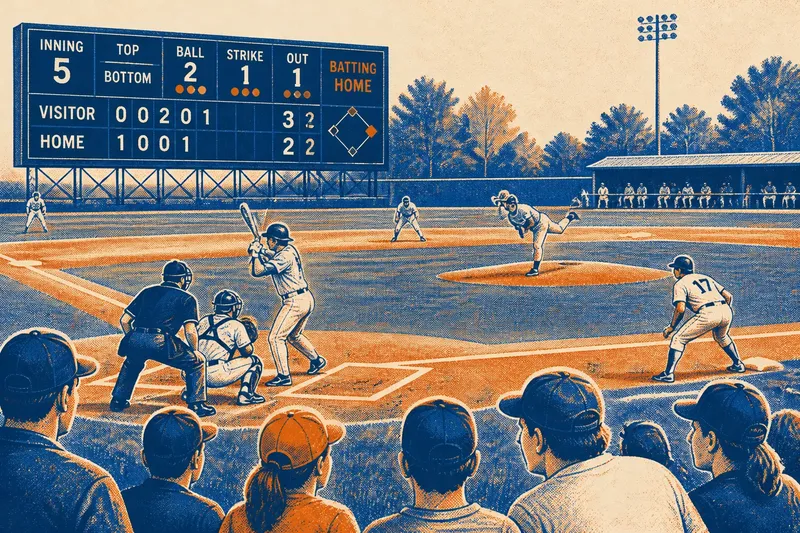
Follow a baseball inning by tracking the count, the outs and the runners. That simple routine makes your first game easier to read: watch the pitch, locate the ball, then see what changes on the bases.
You do not need to learn every rule before finding your seat. An inning gives you a repeating sequence, with a natural reset when the teams change roles. Miss a detail and the scoreboard will usually help you pick up the thread.
Find the field landmarks and scoreboard
Locate home plate, the bases, the pitcher’s mound and the scoreboard. The batter stands at home plate; first, second and third base form a diamond between it and the outfield. The pitcher throws towards the catcher, who crouches behind home plate.
The scoreboard usually shows the inning, which half is being played, the score, the count on the current batter and the number of outs. The display varies by ground, but the count is commonly listed as balls and strikes. A marker may also show which team is batting.
Find the dugouts, where the teams gather when they are not on the field, and the foul lines running from home plate towards the outfield. A batted ball outside those lines is foul, subject to rules about the count and the play. For now, knowing which territory is fair is enough.
Check the ground’s own guidance for entry, permitted items and local procedures. Choose a seat from which you can see both the batter and the bases. Watching only the pitcher is tempting, but the action tends to move elsewhere.
Use the inning to identify who is batting
An inning has two halves. In the top half, the visiting team bats and the home team fields. In the bottom half, the home team bats and the visitors field. “Top” and “bottom” refer to the inning’s place on the scoreboard, not to which team is ahead.
At the start of a half-inning, one batter comes to the plate and faces the pitcher. The other fielders take positions around the infield and outfield. You need only spot the pitcher, catcher, batter and nearest bases to follow the immediate action.
Imagine you arrive just before the bottom half of an inning. The home team is batting, a runner is on first, and the board shows one out. Start with the batter, then glance at the runner as the pitch arrives. If the ball is hit, follow the runner and the fielders; if it is not, check how the count changes. You can understand the next play without reconstructing what happened earlier.
Follow the count, then look up
A strike is generally a pitch the batter swings at and misses, or a pitch that passes through the strike zone without a swing. A ball is a pitch outside the zone that the batter does not swing at. The umpire judges the strike zone; it is not a painted box in front of the plate, though such a box would save spectators some guesswork.
Four balls usually result in a walk, with the batter awarded first base, unless another play or ruling changes what happens. Three strikes usually result in an out, although foul balls and dropped third strikes have exceptions. On a first visit, use the count on the board rather than trying to resolve every unusual situation from your seat.
Between pitches, watch the runners. A runner may lead off a base while the pitcher or catcher keeps an eye on them. The runner can try to advance as the pitch is thrown, and the fielding team can attempt to throw them out. A glance towards the bases as the pitcher begins the motion helps you catch this movement.
After the pitch, return your attention to the ball. A ball caught in the air can produce an out; a ground ball may be fielded and thrown to a base. The batter can run towards first after putting the ball in play, while runners already on base decide whether to advance. Ask first: where is the ball, and which runner is moving?
Use the outs to follow each half-inning
The fielding team tries to record three outs. Common ways include catching a batted ball before it lands, tagging a runner with the ball, or getting the ball to a base before a forced runner reaches it. A force occurs when a runner must advance because the batter has become a runner behind them. These are common patterns, not the full rulebook.
After the third out, the teams switch roles. The batting team’s turn ends, and its players take the field; the other team’s batters come to the plate. If you lose track of the count or a runner, check the scoreboard, see who is coming up and note which team is now defending.
A run scores when a runner touches the bases in order and returns to home plate, subject to the rules governing the play. A home run lets the batter circle the bases and score, usually because the ball has gone beyond the field boundary in fair territory. Other plays can also bring runners home, but the route around the diamond explains the basic movement.
Do not treat every hit as a run. A batter may reach base while other runners stay put, or a runner may advance without scoring. The bases show what might happen next; the score shows what has already happened.
Reset your attention when the inning turns
At the end of a half-inning, check the scoreboard and the field. Confirm the inning and score, identify the team now batting, note the outs and see whether runners are on base. This small reset is more useful than trying to remember every pitch.
During a pitching change, mound visit or other pause, players may move and the next batter may prepare. Check the count if the current plate appearance is still going, or see who is due up next. Pick one detail that will help you follow the next play; the whole display can wait.
Between innings, stretch, get a drink or ask a companion what they noticed. If the crowd reacts before the reason is clear, look towards the bases and then the umpire. If it remains obscure, let the next batter’s turn begin. Baseball offers regular chances to re-enter the plot.
What should you watch during a baseball inning?
What is the simplest way to follow a pitch?
Watch the pitcher release the ball, then notice whether the batter swings and what the umpire calls. Check the count afterwards to see how the plate appearance is developing.
Why do the teams switch sides?
The batting team’s turn ends when the fielding team records three outs. The teams then exchange roles for the next half-inning.
How can you tell whether a runner may advance?
Watch whether the ball is caught, fielded or thrown towards a base. The runner’s decision depends on the play, so follow the runner and nearest fielder rather than assuming every hit means a run.
What should you do if you lose track of the count?
Check the scoreboard before the next pitch and pick up from there. If the display is hard to read, follow the batter and listen for the umpire’s call; the next pause offers another chance to reset.
Keep your first visit uncomplicated
Use the same sequence throughout your first baseball game: identify the batting team, check the count and outs, watch the pitch, follow the ball and runners, then reset at the next out or change of sides. You may gradually notice defensive shifts, signs and reasons for pitching changes, but none is needed to understand the inning in front of you.
It is not worth the effort to memorise a full rulebook before arriving or track every substitution from the first pitch. Finer rules matter when a particular play turns on them; until then, they can wait. Let the scoreboard handle the bookkeeping and keep your attention on the field.
One useful final check is the situation before each pitch: who is batting, how many outs remain and where the runners are. Those three details tell you what the next play could change, even if the previous half-inning is already a blur.