The Myth of One Perfect Grip for Every Tennis Racket
Tennis racket grip size depends on your hand and playing style. Learn what to notice before choosing a handle that feels controlled, not cramped.
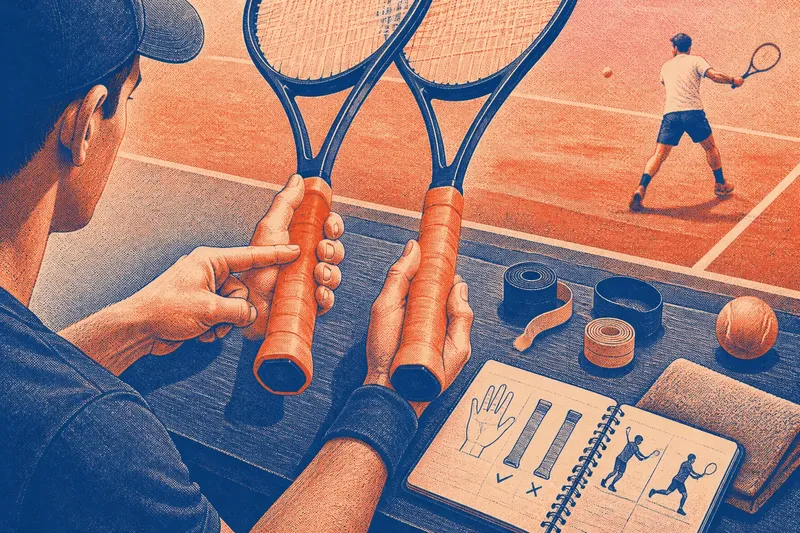
Tennis racket grip size should let your hand hold the handle securely without clenching. The right fit depends on your hand, the strokes you use and the feel you prefer; copying a professional’s choice settles none of those questions.
Grip also means the surface around the handle: an overgrip can alter tack, softness and thickness. Keep those decisions separate. A different surface may improve comfort without changing the underlying handle size, while added layers can make a handle feel too large.
1. Treat grip size as a starting point
Racket handles come in different circumferences, usually identified by a size marking on the butt cap or frame. That marking helps compare rackets, but it does not describe how the handle feels in every hand. Palm width, finger length and the way you hold the racket all affect the fit.
A traditional fit check is to hold the racket in your usual forehand grip and see whether the index finger of your other hand fits into the space between your fingertips and palm. Treat this as a rough guide, not a verdict. Hand shapes vary, and a player who changes grips often may prefer a different feel from someone who keeps the same hand position through most strokes.
If you are choosing between two sizes, try both with the same style of overgrip, or with none on either. Otherwise, you are comparing handles and surface materials at once. The printed size is a starting point for trial, not a ranking of player skill.
2. Let hand comfort set the boundary
A handle that feels too small can encourage the fingers to squeeze, particularly when the racket twists on an off-centre hit. A handle that feels too large may make it awkward to close the hand comfortably or shift between grips. Neither sensation identifies a universal fault; it tells you what to notice while trying a racket.
Look for a relaxed hold while waiting between shots, then notice whether you can tighten it briefly for contact without strain. Pay attention to pressure in the fingers, palm and wrist. Persistent discomfort is a reason to stop relying on rules of thumb and ask a qualified racket professional or clinician, as appropriate.
Imagine you are choosing between two handles at a club shop. The smaller one feels easy to wrap around, but your fingers keep tightening during a shadow swing; the larger one feels secure but restricts a comfortable change from forehand to volley grip. Trying both with the same overgrip gives you a clearer basis for choosing the more relaxed fit. It does not predict how every match will feel, but it makes the comparison less muddled.
3. Match the feel to your stroke habits
Players who use substantial topspin may like a handle they can reposition readily between shots. A player who favours a firm, stable hold at the net may notice different priorities. These are preferences, not rules: swing path, technique and hand mobility matter, and a particular stroke does not dictate one grip size.
Consider how often you change from a forehand grip to a backhand grip, serve or volley position. If the handle feels awkward during those transitions, the issue may be its shape or surface rather than its circumference. Some rackets have more pronounced bevels, the angled faces that help the hand locate a grip position. Those bevels can feel clear in the palm or more prominent than you want.
Do not choose a larger handle solely because another player says it steadies the racket, or a smaller one because someone says it creates more spin. Those claims detach grip from the player using it. Ask instead whether you can hold the racket with control while changing strokes without unnecessary tension.
4. Separate handle size from overgrip choice
An overgrip is a replaceable strip wrapped around the racket’s base grip. It can change tack, absorb moisture and soften the contact under your fingers. Its texture and thickness alter the sensation, but adding one also makes the handle feel larger.
A tacky surface may suit a player who wants the racket to feel secure in the hand. A softer, more absorbent surface may feel preferable during longer sessions or in humid conditions. Smoothness, cushioning and edge definition are personal trade-offs. A heavily cushioned wrap can make the bevels less distinct; a thin wrap may preserve their outline but feel less soft.
There is little value in layering overgrips repeatedly to correct a fundamentally uncomfortable handle. It can blur the bevels and change the size more than intended. Start with one suitable wrap, then judge the surface and handle separately rather than treating every discomfort as a request for more material.
5. Test choices in ordinary play
A racket can feel convincing in a shop and different after a rally, when the hand is warm and the player is moving. If you can borrow or demo rackets, compare them during familiar drills: forehands, backhands, serves and volleys. Keep the ball, racket model and grip surface as similar as possible, changing one feature at a time.
Notice whether your hand stays relaxed between shots, whether grip changes feel natural and whether the handle rotates uncomfortably on contact. These observations are more useful than judging a racket by a single hard hit. Do not make the comparison a contest of who can swing fastest; a grip that only feels manageable under maximum effort is not a persuasive choice.
Say you normally play from the baseline and are considering a handle one size larger because a doubles partner recommends it. Borrowing a racket with that handle, while keeping the overgrip similar, lets you compare the feel during your usual rally and a few volleys. If the larger handle feels secure but makes transitions cumbersome, that is a practical reason to keep looking rather than follow the recommendation.
6. Ask the right questions before settling on a grip
Can I make a racket grip smaller?
Removing an overgrip can reduce the added bulk, but changing the racket’s underlying handle is a separate alteration. A specialist can explain suitable options for the particular frame; avoid improvised changes that leave the handle uneven or uncomfortable.
Can I make a racket grip larger?
An overgrip adds some thickness and changes the surface feel. If that still leaves the handle uncomfortable, ask a racket technician about compatible methods rather than stacking wraps until the bevels disappear.
Should I copy a professional player’s grip size?
No. A professional’s hand, technique and preferred racket setup may differ from yours, and a visible racket label does not tell you how the handle feels in use. Treat another player’s choice as a conversation starter, not a shortcut.
When should I replace an overgrip?
Replace it when it becomes slick, worn or unpleasant to hold, or when it stops absorbing moisture as you expect. Follow the wrap maker’s directions for fitting; the racket manufacturer’s guidance also matters where a handle alteration is involved.
For tennis racket grip size, choose the handle that lets your hand stay comfortable while you move between the strokes you actually play. Borrowing a favourite player’s preference may be harmless, but your fingers still have to live with it. Check the handle, bevels and overgrip as separate parts of the decision; the most elaborate adjustment is often the least worth attempting.