Why the Oval Exists in Cricket
Why the oval exists in cricket: understand how the boundary shapes the field of play, while the pitch and changing action define what happens inside it.
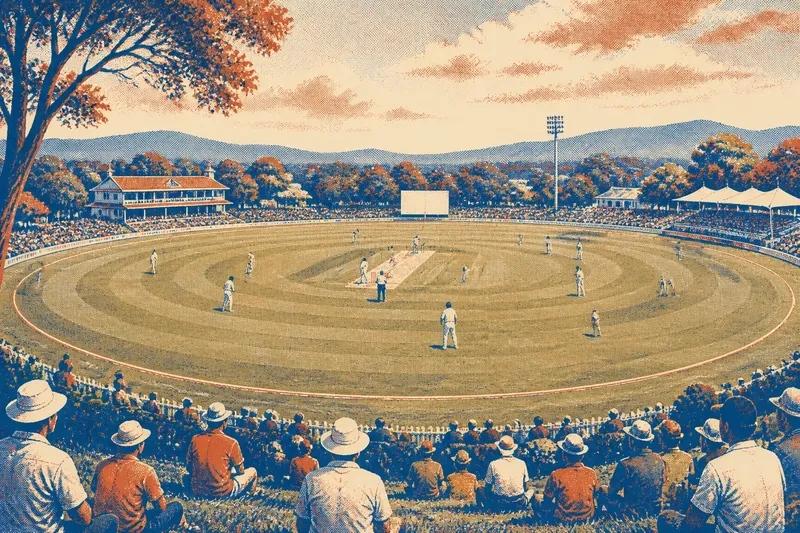
A cricket ground’s oval shape gives the match a clear outer field, but it does not dictate the play inside it. The boundary marks where the ball stops being in the field of play; the pitch, wickets and players determine what happens before that point. That distinction explains why two grounds can share the same broad shape yet produce quite different matches.
The oval is a boundary, not a diagram of the action
Cricket is played on a large area of grass, usually enclosed by a boundary. The ground is often oval or roughly circular because a continuous edge can surround the field without corners becoming special points of play. The shape is practical, but it is not a template that dictates where every player stands or how the ball must travel.
Inside that outer edge sits the pitch: a prepared strip of ground with a wicket at each end. The bowler delivers the ball along this strip towards the batter. The pitch is usually near the centre of the playing area, though its exact placement and the ground’s outline vary. The oval describes the enclosure; the pitch supplies the match’s central axis.
That makes the word “oval” slightly misleading if taken too literally. Some grounds are elongated, irregular or altered by roads, stands and other boundaries. What matters for play is the marked boundary and the usable field within it, not whether the perimeter resembles a tidy geometric drawing.
The boundary turns open grass into a playing field
The boundary is the edge of the area in which the ball can be fielded. It may be marked by a painted line, a rope, a fence or another visible feature. The precise marking affects decisions: a ball that reaches or passes the boundary can score differently from one that stays inside and is returned by a fielder.
In broad terms, a ball hit beyond the boundary scores four if it has first touched the ground inside the field, and six if it crosses without touching down. The boundary therefore gives the field a scoring edge as well as a physical one. It tells players and officials where a ball has left active play, while giving batters a target whose difficulty depends on the distance and shape of that edge.
The edge need not be equally far from the pitch in every direction. A ground may be longer straight down the pitch than across it, or have one side that comes in closer. This unevenness changes the routes available to a batter and the ground a captain can ask fielders to cover. The oval supplies an overall enclosure; its proportions supply local conditions.
The pitch organises play within the oval
The match does not unfold as a contest to occupy the whole oval. It repeatedly returns to the pitch, where the bowler, batter and wicketkeeper meet the delivery. Batters can run between the wickets after striking the ball, while fielders spread into the surrounding grass to stop runs or attempt a dismissal.
That arrangement separates two kinds of space. The pitch is a defined, prepared strip where the ball is delivered and the batters’ ends are established. The outfield is the larger surrounding area in which the ball travels and fielders pursue it. The boundary encloses both, but it does not make them interchangeable: a ball can be in the outfield without being close to leaving the ground.
Fielding positions are also not fixed by the oval’s geometry. A captain may place players near the batter, farther out, or in a particular direction according to the bowler, batter and match situation. The same ground can therefore look crowded on one delivery and widely spread on the next. The boundary remains still; the field arrangement changes around the pitch.
Ground dimensions make the same shape play differently
Two grounds can both be described as ovals and still offer different challenges. The distance from the pitch to the boundary can vary by direction, as can the quality and pace of the outfield. A ball that reaches a nearby edge might be stopped short at a more distant one, giving fielders more time and the batter less reward for the same stroke.
Surface conditions matter too. The pitch influences how the ball behaves after bouncing, while the outfield affects how quickly it moves after passing the infield. These are related but separate features. A large oval does not, by itself, mean that scoring will be difficult, and a compact one does not make every hit a boundary.
Imagine a ground with a shorter boundary on the leg side and more open space straight down the pitch. A batter who notices the difference might favour shots towards the shorter side, while the captain places a fielder there and leaves more room elsewhere. The expected visible result is a change in the field and in the directions the batter chooses, not a change to the oval or the rules. That is how ground dimensions enter the contest without defining it.
What does the oval change during a match?
Why are cricket grounds usually oval?
A rounded enclosure gives the field a continuous edge around the pitch and outfield, without corners that would create unusually short or awkward sectors. The shape is common, not compulsory; grounds can be irregular while still providing a clear playing boundary.
Does the oval shape decide where fielders stand?
No. Fielders take positions chosen for the delivery, batter and match situation. The ground’s dimensions affect how much space they must cover, but the shape does not prescribe a standard arrangement.
Is the pitch the same thing as the oval?
No. The pitch is the prepared strip between the wickets, while the oval is the larger ground enclosed by the boundary. The pitch structures each delivery; the surrounding field gives the ball room to travel and be fielded.
Can a boundary be an irregular shape?
Yes. A cricket ground can have an uneven perimeter, provided its boundary is clearly identified for play. The resulting differences in distance from the pitch affect tactics, even though the basic roles of pitch, outfield and boundary remain distinct.
The ground’s edge matters most when the ball reaches it
For most deliveries, the oval is a setting rather than an active feature. The batter watches the ball, the bowler works from the pitch and fielders respond to the stroke. The boundary becomes decisive when the ball approaches the edge: it marks the point where fielding ends and the boundary scoring rule applies.
That is why the oval exists as more than a convenient outline. It defines the extent of the field while leaving the central contest to the pitch and the people moving around it. If you want to understand a cricket ground, start with the boundary, then locate the pitch and notice how much grass lies between them in each direction. The shape gives the game its outer limit; the changing space inside gives each ground its character.